Niemann-Pick type C happens when cells can’t move cholesterol where it needs to go. It can appear in infancy, childhood, or — more often than people expect — in the teen and adult years.
~500 diagnosed cases worldwide | Treatments now available | Genes: NPC1 & NPC2

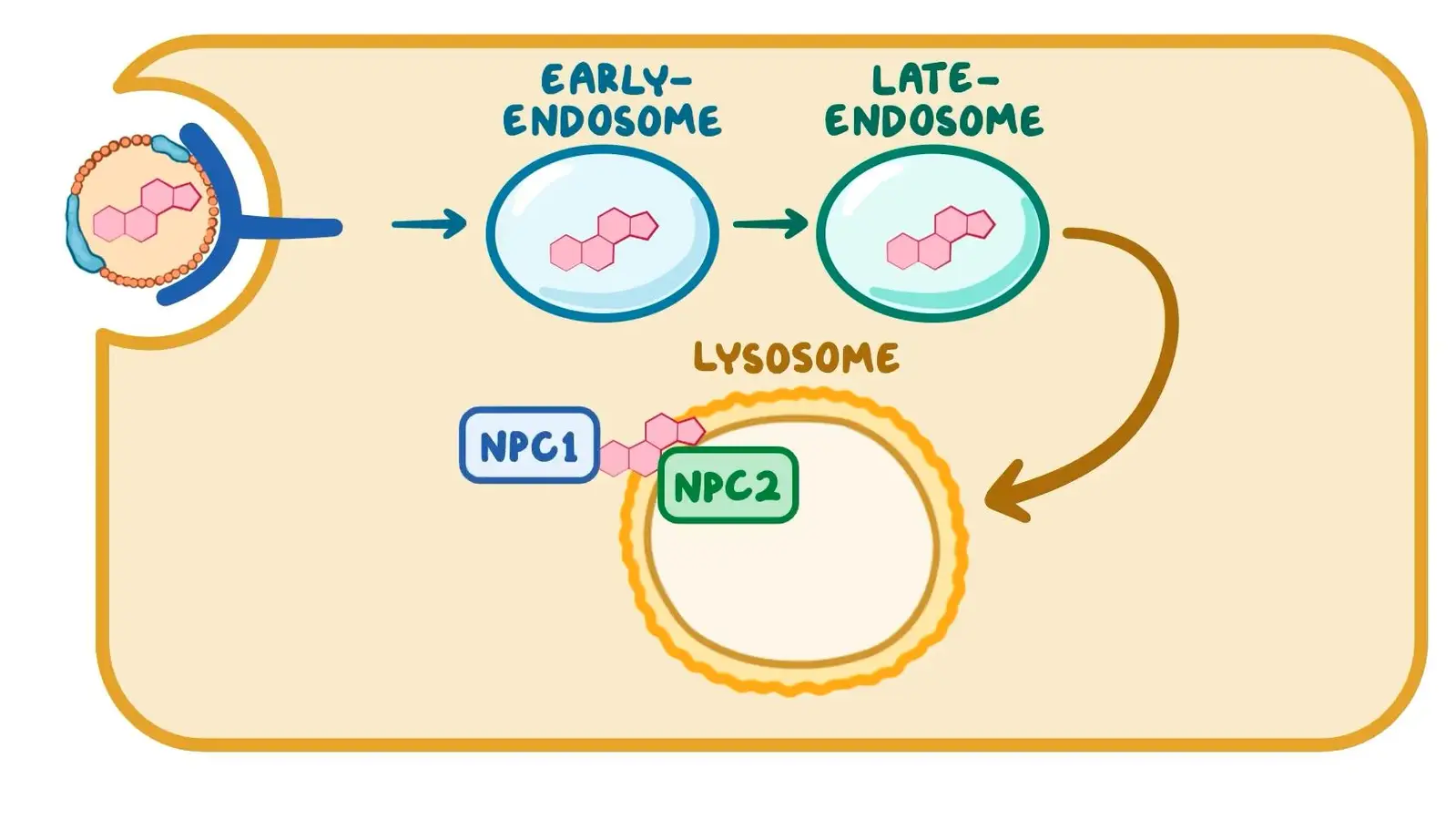
Build-up inside the lysosome.
Cholesterol, and in the brain other fats such as sphingolipids, get trapped and pile up.
Shortage everywhere else.
The rest of the cell can’t get the cholesterol it needs to build membranes and signal properly. The cell senses the shortage and both pulls in and makes even more cholesterol, which also gets trapped, making the build-up even worse.
Both problems drive the disease. The build-up is why the liver and spleen enlarge; the combination of build-up and shortage is what harms nerve cells in the brain.
Watch: Niemann-Pick Disease Type C (NPC): Causes, Symptoms & Treatment (NORD, 6 min)
NPC can show up at almost any age. As a general pattern, the later symptoms begin, the more slowly the disease tends to progress.
Earlier onset,
faster progression
Later onset,
slower progression
Early Infantile
Developmental delay is often the first clue, with motor skills (sitting, crawling, walking) affected more than thinking and language. Low muscle tone, an enlarged liver or spleen, and prolonged jaundice in the newborn period are also common. Neurological symptoms tend to progress more quickly in this form.
Diagnosed in the first weeks or months of life? A smaller number of babies with NPC are affected more quickly. Get information and support for an early diagnosis →
Late Infantile
Clumsiness, unsteady walking, and delayed or unclear speech are frequent early signs, often alongside an enlarged liver or spleen. Trouble moving the eyes up and down (vertical gaze palsy) may appear. Seizures and sudden loss of muscle tone (cataplexy) can develop as the disease progresses.
Juvenile
The most typical presentation. School and learning difficulties, clumsiness, and vertical gaze palsy are common early clues, followed by slurred speech, swallowing problems, cataplexy, or seizures. An enlarged liver or spleen may be mild or absent.
Adolescent & Adult
Early symptoms are often psychiatric — depression, psychosis, or behavior changes — or subtle problems with memory, thinking, balance, or coordination, and are frequently mistaken for a mental health condition. Progression is typically slower than in earlier-onset forms.
Often only one or two symptoms appear at first — no single sign confirms it, but it’s worth a conversation with a doctor.
Often first in babies and young children (0–5)
Delayed motor milestones or low muscle tone
Enlarged liver or spleen, or prolonged jaundice in newborns
Unsteady walking or clumsiness
Delayed or unclear speech
Often first in school-age children and teens (6–15)
Vertical gaze palsy, trouble moving the eyes up and down
Learning or school difficulties, sometimes mistaken for a learning disability
Slurred speech or trouble swallowing
Seizures, or sudden loss of muscle tone when laughing or surprised (cataplexy)
Often first in teens and adults (16+)
Changes in mood, behavior, or thinking, including depression or psychosis
Problems with balance, coordination, or memory
Vertical gaze palsy
NOTE: Symptoms overlap across groups; the age tags indicate where each is most often the first sign, not the only place it occurs. For a more detailed, age-by-age list of symptoms, see the current NPC clinical guidelines.
Because NPC is rare and symptoms vary so widely, diagnosis can take years — NNPDF can help you find a care clinic.
Outlook is closely tied to age of onset: early and late infantile forms tend to progress more quickly, while juvenile and especially adolescent/adult forms typically progress more slowly. Every person’s course is different, and this is one of the most important conversations to have directly with your care team.
Two FDA-approved treatments — Miplyffa® (arimoclomol) and Aqneursa® (levacetylleucine) — are now available and can help manage certain effects of NPC. Research continues, and NNPDF can help you find specialists experienced with NPC.
Two FDA-approved treatments are now available — Miplyffa® (arimoclomol) and Aqneursa® (levacetylleucine) — which can help manage certain effects of NPC.
Financial assistance programs can help with treatment costs, genetic testing, and travel to specialists.

See and hear about the science behind NPD and from those who have experienced it.
A short animated introduction to Niemann-Pick diseases and what happens inside the body’s cells.

Some people aren’t diagnosed until their teens or adulthood, and early symptoms are sometimes mistaken for something else entirely. If this sounds familiar, you’re not imagining things — and you’re not alone.
NNPDF’s NPC community includes families across every point on the spectrum, from a new diagnosis to teens and adults living with NPC.
Become an NNPDF member for the latest research updates, event invitations, and a direct line to the community.